
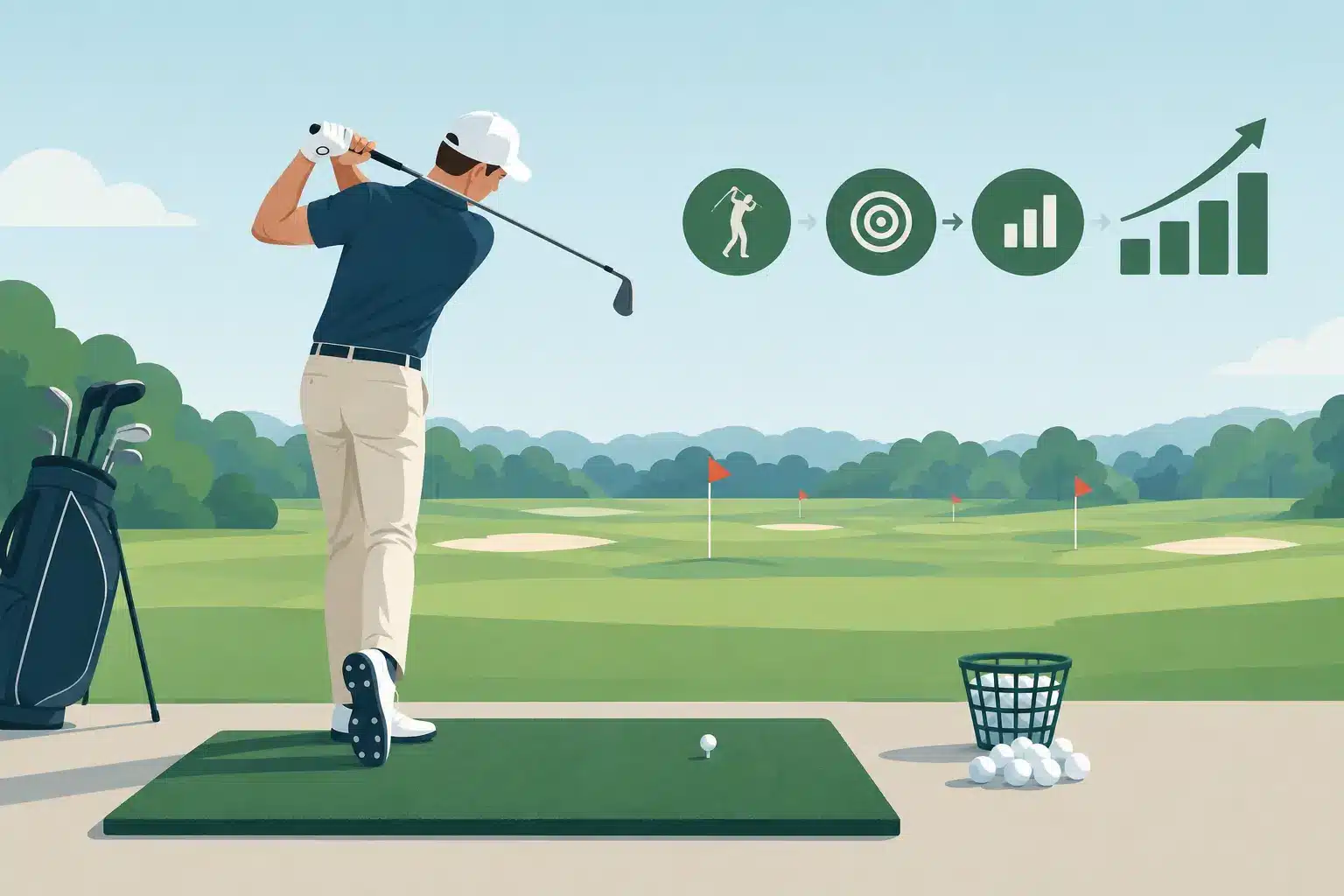
Golf Practice Routine Guide for Measurable Gains
A bucket of balls can make you tired without making you better. If your practice is built around whatever club feels good that day, you are rehearsing motion, not building performance. This golf practice routine guide gives serious players a repeatable system for turning limited practice time into lower scores.
The objective is not to hit more shots. It is to identify the shot that costs you, train it with a purpose, measure whether it improves, and carry that improvement onto the course. That requires structure, honest feedback, and enough repetition to make a better decision feel familiar under pressure.
Start With the Scorecard, Not the Swing
Most golfers begin a session with a swing thought. Start with your last few rounds instead. Look for the pattern behind the dropped shots: penalty drives, approach shots missing on one side, three-putts, poor distance control, or weak contact late in the round.
Choose one primary performance target for the next two to four weeks. It might be reducing a right-side driver miss, improving proximity from 125 to 150 yards, or eliminating short-putt misses. One target does not mean ignoring the rest of your game. It means your highest-quality work has a clear destination.
Be specific enough to measure. “Hit better irons” is vague. “Start 7-irons within a 10-yard window of the target line and carry them 155 to 160 yards” gives you a standard. A defined standard also tells you when a technical change is helping and when it is only producing a few attractive swings.
If you use launch-monitor data, prioritize numbers that connect directly to your target. For a driver, that may be face-to-path, strike location, launch, spin, and dispersion. For irons, focus on carry distance, landing pattern, low-point control, and start direction. More data is not always better. The right data is data you can act on.
Build a Golf Practice Routine Around Four Phases
A productive 60- to 90-minute session has four jobs: prepare your body, improve a skill, test it under changing conditions, and record what happened. Skipping the testing phase is one reason range progress often disappears on the first tee.
1. Prepare for 10 Minutes
Arrive with intention. Use mobility work that prepares rotation, hip stability, thoracic movement, and wrist motion, then make a few controlled swings. The goal is not a workout. It is to establish the movement quality you need before you ask your body to produce speed.
Hit a small number of short shots with a wedge or mid-iron, paying attention to centered contact and tempo. Avoid making technical judgments from the first five balls. Your body may still be warming up, and early feedback is often noise.
2. Train One Skill for 25 to 35 Minutes
This is your development block. Work on the priority you selected from your on-course performance. Use a drill, a target, and a measurable success criterion.
If your goal is better face control with the driver, do not simply hit driver after driver. Make rehearsal swings, use a start-line reference, and hit sets of five balls with a clear intended shape. Review the pattern after each set. If the ball flight and measurement disagree with your feel, trust the result. Feel is useful, but it is not a scoreboard.
Technical practice has a place, particularly after a PGA professional identifies a movement pattern that limits your game. But technical changes should be simple enough to repeat. If you are juggling three body positions and two timing cues, you may be creating confusion rather than a new skill.
3. Transfer the Skill for 15 to 25 Minutes
Now make practice look more like golf. Change clubs, targets, and shot requirements. Go through your full pre-shot routine before every ball. One ball, one decision, one consequence.
A useful transfer game is to play six to nine simulated approach holes. Choose a realistic tee-shot result, then hit the approach you would face from that position. Record whether you hit the green, your expected miss, and whether the shot finished in a position that would leave a reasonable next shot.
For driving, create a fairway window and assign a penalty to misses that would be out of bounds or blocked by trees. For wedges, alternate yardages rather than hitting ten balls to the same number. Random practice can feel harder than block practice because it is harder. That is precisely why it travels better to the course.
4. Close With Evidence for 5 Minutes
Before you leave, write down three things: the metric you trained, the result you produced, and the next adjustment. Keep it short. “Driver start line improved when I used a slower takeaway. Eight of 12 finished inside my fairway window. Next session: maintain that cue while changing targets.”
This record prevents every session from becoming a new experiment. It also gives your coach something valuable: evidence from multiple sessions rather than a memory shaped by your best swing.
Give Putting Its Own Standard
Putting is too often treated as a warm-up activity, even though it has the fastest path to meaningful score improvement for many players. It deserves a defined portion of your weekly practice time.
Separate putting into start line, pace, and green reading. A golfer can read the right amount of break and still miss because the ball starts offline. Another can start it perfectly and leave every putt short. Train the component that is failing rather than rolling putts without a diagnosis.
Use a simple progression. Begin with straight putts from three to six feet to calibrate face control and setup. Then move to distance-control work from 20 to 40 feet, where the goal is a consistent leave zone rather than makes. Finish with consequence-based putting: make a sequence of short putts in a row, or restart after a miss.
Visualization technology can make this work more precise by showing intended line, actual roll, and pace relative to the hole. That feedback is valuable, but only if you keep the training challenge realistic. A perfect read on a projected line does not replace learning how to commit to a putt when the match is close.
Schedule Practice Like a Player Who Competes
Three focused sessions per week will usually outperform one long, unfocused session. The exact split depends on your weaknesses, upcoming events, and how often you play. A player losing strokes off the tee should not spend 80 percent of practice time on 40-yard pitch shots. A player with recurring three-putts should not expect a new driver to solve the problem.
A strong weekly framework might include one full-swing development session, one putting and scoring-wedge session, and one transfer session built around simulated course play. Add golf fitness two or three times per week, with an emphasis on mobility, strength, and power that supports your current swing work.
The trade-off is simple: technical practice creates change, while performance practice creates trust. If your swing is being rebuilt, lean more heavily into development work for a period of time. As a tournament, member-guest, or important business round approaches, shift toward targets, routines, pressure games, and course simulation. You are not trying to find a new move the day before you need to score.
Use Technology to Stop Guessing
Video alone can be misleading. A position may look different without changing the club delivery or ball flight that matters. Likewise, a launch monitor can show a pattern without explaining the movement creating it. The best practice environment connects motion, impact, and outcome.
At Ethos Golf, a private practice setting can combine Sportsbox 3D movement data, TrackMan ball-flight measurement, PuttView feedback, and golf fitness work in one focused session. The benefit is not technology for its own sake. It is faster diagnosis, clearer priorities, and a plan you can repeat without waiting for weather, range space, or a free hitting bay.
Use measurement to establish a baseline first. Then change one variable at a time. If you alter grip pressure, ball position, and backswing length in the same session, you will not know what produced the result. Precision comes from controlled experimentation.
Know When to Ask for Coaching
Self-practice works well when you have a clear objective and reliable feedback. It breaks down when the same miss persists, your ball flight changes from day to day, or your fix creates a different problem elsewhere in the bag.
Elite coaching is especially valuable when a player is chasing speed, recovering from pain, preparing for competition, or making a meaningful technical change. A qualified PGA professional can distinguish between a temporary timing issue and a pattern that needs a different setup, movement strategy, or practice design.
The right coaching relationship should make you more independent, not more dependent. You should leave with a priority, a drill you understand, a metric to watch, and a defined plan for testing the change on the course.
Your next practice session does not need to be longer. It needs to answer a question. Pick the shot that is holding back your score, measure it honestly, and give it enough disciplined attention that better golf becomes repeatable when it counts.


Golf Strength Training for More Speed and Control
A hard swing that loses posture through impact is not a power swing. It is a compensation. The golfer who can create force, control it, and repeat it late in a round has an advantage that no new driver can manufacture. Golf strength training is how serious players build that advantage.
The goal is not to become a bodybuilder or chase a personal record that has no place in your golf swing. The goal is to produce more club speed, protect the joints that absorb rotational stress, and give your swing coach a body capable of executing the movement you are building. Stop guessing whether your body is helping your game. Train the qualities your game actually demands.
What Golf Strength Training Should Improve
A better golf body does four things well: it creates force through the ground, transfers that force through the torso, controls rotation, and maintains positions under fatigue. Those qualities show up as more speed, a more stable strike pattern, and fewer rounds where your back, hips, or shoulders become the limiting factor.
Distance gets the attention, but strength can also improve accuracy. When your legs and trunk are strong enough to support the swing, you are less likely to stand up, slide excessively, lose your pelvis position, or throw the club with your hands to find the ball. Physical capacity does not replace sound mechanics. It gives sound mechanics a better chance to hold up at full speed.
This is why generic workouts often miss the mark. A program built only around chest presses, curls, and random high-rep circuits may improve general fitness, but it does not necessarily address how a golfer rotates, shifts pressure, stabilizes, and decelerates. Golfers need strength with a clear transfer to movement.
Start With Your Movement Limits
Before adding load, find the restriction that is forcing a compensation. For one golfer, it may be limited lead-hip internal rotation. For another, it may be poor thoracic rotation or an inability to control a single-leg position. More weight will not solve a mobility issue, and stretching alone will not create control.
A useful assessment looks at hip mobility, ankle motion, shoulder range of motion, trunk rotation, balance, and the ability to hinge, squat, push, pull, and rotate without losing position. It should also consider your swing pattern. If 3D analysis shows early extension, for example, the answer is not automatically stronger glutes. The player may need better hip mobility, improved pressure shift, trunk control, or a technical change. Usually, it is a combination.
At Ethos Golf, physical training belongs in the same performance conversation as swing data and ball flight. When your movement screen, Sportsbox 3D measurements, and TrackMan numbers point in the same direction, training stops being a separate project. It becomes part of the plan for your next round.
Build Strength From the Ground Up
Golf is played on your feet. Your lower body creates a stable platform and contributes significantly to the forces that move through the club. That does not mean every golfer needs to load a barbell heavily. It means the training plan needs progressive lower-body work that respects your current ability and your golf schedule.
Squat variations, split squats, step-ups, deadlift patterns, and hip hinges are productive options when coached well. Split-stance and single-leg exercises deserve special attention because golf requires you to manage pressure from one side of the body to the other. They also expose side-to-side differences that two-footed exercises can hide.
The right variation depends on the golfer. A player with limited ankle motion may not be ready for a deep squat pattern, while a golfer with a history of back pain may benefit from a carefully coached trap-bar deadlift or elevated hinge variation before loading conventional deadlifts. The exercise is not the point. The movement quality and progression are.
Do not confuse instability with golf specificity. Doing every exercise on a balance pad can reduce the load your muscles can produce and make it harder to progress. Build strength on stable surfaces first. Then use targeted balance and single-leg work to improve control where it matters.
Train the Core to Transfer and Resist Force
Your core is not simply a set of abs to make visible. In the golf swing, the trunk must manage rotation between the pelvis and rib cage, stabilize the spine, and transfer force from the ground into the arms and club. That requires both motion and control.
Anti-rotation presses, carries, dead bugs, controlled plank variations, and cable holds can build the ability to resist unwanted motion. Rotational cable patterns, medicine-ball throws, and chops can train purposeful rotation when the golfer has enough control to earn speed. Both categories matter.
A common mistake is to add fast rotational exercises too early. If you cannot maintain rib cage and pelvis control during a slow cable rotation, throwing a medicine ball harder only rehearses a leak. Build the brakes before asking for more engine. Then progress from controlled patterns to explosive work with intent and adequate rest.
Use Power Work for Speed, Not Fatigue
Strength creates the capacity to produce force. Power work teaches the body to express force quickly. For golfers who want more speed, this is where jumps, throws, and speed-focused swings can earn their place.
The key is quality. A medicine-ball scoop toss, a rotational shot-put throw, or a low-volume jump should be fast, crisp, and repeatable. When the throw slows down or landing mechanics deteriorate, the set is over. Power training is not conditioning.
Two to four repetitions per set is often plenty for explosive drills, with meaningful rest between efforts. The exact volume depends on training age, injury history, and total workload. A competitive player practicing daily and playing on weekends cannot train like an off-season golfer with a lighter schedule.
Overspeed and speed-stick protocols can also be useful, but they are not a shortcut around strength, mechanics, or recovery. If your body cannot control the speed you create, you may simply reinforce poor sequencing. Pair speed work with objective measurement so you know whether your club speed, centeredness of contact, and ball speed are actually moving in the right direction.
Keep the Upper Body Strong Enough to Support the Swing
Golfers need strong shoulders, upper backs, arms, and grip. The club moves quickly, and the body must both accelerate and decelerate it. A balanced program includes pressing and pulling, but pulling volume often deserves extra attention for players who sit at a desk, round their shoulders, or struggle to maintain posture.
Rows, pulldowns, presses, push-ups, carries, and external-rotation work can all fit the program. The priority is clean movement through a comfortable range of motion. Shoulder training should not create pain or chase extreme flexibility. A stable, capable shoulder is more valuable than a loose joint with no control.
Grip strength has a practical role, too. It can help golfers maintain control of the club without excessive forearm tension. Carries, hangs, and controlled wrist work are straightforward ways to develop it. But do not use a grip-strength routine so aggressively that your forearms are exhausted before practice.
A Weekly Plan That Fits Real Golf
Most adult golfers do not need six lifting days. They need two focused full-body strength sessions each week, plus one optional lighter power or mobility session when their schedule allows. Consistency beats an ambitious plan you abandon after two weeks.
A full-body session might include a lower-body strength pattern, a hinge or single-leg pattern, one push, one pull, a trunk-control exercise, and a small amount of power work. Keep the session efficient. Forty-five to sixty minutes of deliberate training is enough when the program is organized and the effort is real.
Avoid hard leg training the day before an important round if it leaves you sore or changes how you move. Some golfers tolerate strength work well before playing; others need 48 hours to feel fresh. Test your response rather than following a rigid rule. The right schedule is the one that improves your performance without making golf feel heavier.
Measure What Carries to the Course
The gym is not the scoreboard. Your scorecard, dispersion pattern, club speed, ball speed, and ability to finish strong are. Track a few meaningful markers over time: your training loads, key mobility measures, driver speed, strike quality, and how your body feels after 18 holes.
If strength is increasing but your speed and movement quality are not improving, reassess. You may need more power work, a swing adjustment, better recovery, or a simpler program. If speed rises but contact becomes inconsistent, the answer may be technical practice rather than another conditioning session. The best plan responds to evidence.
Train with purpose, then test your work where it counts. A stronger body should make golf feel more repeatable: better pressure into the ground, more control through impact, and more confidence when the round is still on the line.

What a Free Golf Swing Assessment Reveals
A missed fairway is rarely caused by one bad thought. It is usually the visible result of a pattern: a club delivered too far from the inside, pressure that never reaches the lead side, early extension, or a sequence that costs both speed and face control. A free golf swing assessment gives that pattern a name, measures it, and turns an uncertain practice routine into a clear starting point.
For committed golfers, that matters. You do not need another bucket of balls spent chasing a tip that worked once. You need to know what your swing is doing, why it is doing it, and which change deserves your attention first.
What a Free Golf Swing Assessment Should Actually Do
A worthwhile assessment is not a quick glance at your swing followed by a generic instruction to keep your head down. It should establish a baseline for how you move the club and body, then connect that motion to the ball flight and misses you see on the course.
At Ethos Golf, the process is built around objective feedback rather than opinion. Sportsbox 3D Studio can measure the movements that a phone video can suggest but cannot reliably quantify. It evaluates the relationship between your body, the club, and key positions throughout the swing without forcing you to guess whether a change is real.
The goal is not to build a swing that looks like someone else's. Good players have different grips, tempos, and backswing shapes. The assessment identifies the elements that matter most to your performance: how you create speed, control the clubface, manage low point, and repeat your delivery under pressure.
A strong session should leave you with three things: an explanation of your primary pattern, a clear sense of its effect on your ball flight, and a logical next step. That may be a technical adjustment, a physical capacity priority, a better practice structure, or a combination of all three.
Stop Treating Symptoms and Find the Source
Golfers often practice the symptom because it is the part they can see. A slice invites an over-the-top correction. Thin iron shots invite an effort to stay down. A loss of distance invites an attempt to swing harder.
Those responses can make sense in the moment, but they do not always address the source. A club path issue may begin with how the pelvis moves in transition. Inconsistent strike may come from pressure shifting too late, limited lead-hip motion, or an attempt to manufacture a position at impact. Lost speed may be a sequencing problem, not a strength problem.
This is where measured analysis earns its value. Rather than asking, "What should I try?" you can ask a more useful question: "What is the smallest change most likely to improve my result?"
That distinction protects your practice time. If your face-to-path relationship is already the main issue, rebuilding your backswing may be unnecessary. If your movement pattern is restricted by mobility or stability, repeating a swing drill without a physical plan may only reinforce the compensation. Precision means knowing what not to change as much as knowing what to work on.
The swing and the ball flight must agree
Numbers are useful only when they tell a coherent story. A 3D analysis should be considered alongside launch and ball-flight data, your typical miss, your scoring goals, and the shots that disappear when the round matters.
For example, a player who fades the driver by design may not need a draw. But if that fade becomes a weak block under pressure, the assessment can separate a playable stock shape from a delivery pattern that limits distance and fairway control. The same applies to a golfer whose iron contact is acceptable on a mat but unreliable from turf.
Your assessment should respect the golf you actually play. A competitive amateur preparing for tournament golf has different demands than a busy professional seeking more reliable tee shots and a better chance to break 80. The data is the starting point. The performance goal determines the plan.
What You May Learn From Your Swing Data
The most useful findings are often less dramatic than golfers expect. You may discover that the issue is not a wildly flawed motion but a small inconsistency at a high-leverage moment.
A free golf swing assessment can reveal whether your body is creating enough separation and sequence to produce speed efficiently. It can show whether the club is steepening or shallowing in transition, whether you are losing posture through impact, or whether your lead-side mechanics are making it difficult to control the bottom of the swing.
It may also identify a mismatch between intention and motion. Many golfers feel as if they are rotating through the ball while their measured pattern shows the pelvis stalling and the arms taking over. Others believe they are coming over the top when the larger issue is an open clubface that forces them to make a last-second adjustment.
There is no prize for having a technically perfect model. The standard is repeatable performance. Can you start the ball where you intend? Can you control curvature? Can you produce enough speed without timing everything perfectly? Can you make the same move on the 17th tee as you do in a comfortable practice bay?
Why Video Alone Is Not Always Enough
Video remains valuable. It gives golfers a clear visual reference and makes certain changes easier to understand. But a camera angle can be misleading, and it cannot fully measure the three-dimensional relationship between body segments, club movement, and timing.
A swing can look on-plane from down the line while still delivering the club in a way that produces inconsistent strike. A player can appear to rotate well while shifting pressure inefficiently. Two golfers can look similar at the top yet create very different club delivery patterns through impact.
That does not mean every golfer needs to chase data for its own sake. Too many numbers can be as distracting as too many swing thoughts. The right approach is selective: measure what explains your current result, establish a benchmark, and use the information to make one meaningful priority clear.
For serious players, the advantage is accountability. You can return to the same measured environment and see whether the work is producing change. Feel is useful, but feel is personal. Measurement tells you whether the change is holding up.
Turn Assessment Into a Practice Plan
An assessment is valuable only if it changes what happens next. The best follow-up plan is simple enough to execute and specific enough to measure.
Start with one technical priority. If the diagnosis points to a late transition pattern, your drills, rehearsal, and feedback should reinforce that change rather than introducing three unrelated cues. Then establish a way to check progress. That could be a movement measurement, a start-line window, a contact pattern, or a TrackMan number tied directly to the issue.
Next, consider whether your body supports the change. Some patterns are learned habits. Others are practical workarounds for limited mobility, stability, or strength. Dedicated golf fitness work can help make the better movement available, but it should serve the swing goal rather than exist as a separate project.
Finally, take the improvement into performance. A new motion needs to survive target selection, consequences, and changing clubs. Use practice that includes random targets, different shot shapes, and realistic decision-making. Virtual golf can expose whether your new pattern remains reliable when every swing has a score attached.
Who Benefits Most From an Assessment?
The answer is not only golfers with obvious struggles. A player who has plateaued at the same handicap for years may benefit as much as someone fighting a slice. Plateaus often happen because practice becomes familiar rather than deliberate.
It is especially useful if you regularly say any of the following: you are not sure why your good range swing disappears on the course; your driver and irons require different feels; you have lost distance; your strike changes from day to day; or you have tried multiple lessons without a clear picture of the pattern.
There are trade-offs. An assessment does not promise an overnight rebuild, and the right fix may initially feel uncomfortable. It also cannot replace focused repetitions or quality coaching. What it can do is prevent you from investing that effort in the wrong direction.
For golfers in Frisco and Allen who treat improvement as a serious pursuit, a private, measured environment removes the usual friction: weather, crowded bays, limited feedback, and practice sessions that end before you find a useful answer. Your time is valuable. Your practice should show you something.
Bring your normal swing, your honest ball flight, and the goal that matters most to you. Whether that goal is more speed, tighter dispersion, cleaner iron contact, or greater confidence under pressure, the first number worth finding is the one that explains where your current swing is costing you shots.

Private Golf Practice Frisco for Better Scores
A productive golf session should not begin with searching for an open bay, waiting on a mat, or wondering whether your range balls reflect your real distances. Private golf practice Frisco golfers can rely on changes that equation. It gives committed players a controlled place to train, measure progress, and build confidence when their schedule allows - not only when the weather and practice facility cooperate.
For the player who wants lower scores, more practice is not automatically better. Better practice is specific, repeatable, and connected to what happens on the course. That requires a setting designed for development rather than entertainment.
Why Private Golf Practice in Frisco Changes the Work
Public ranges have a purpose. They are accessible, social, and useful for getting loose before a round. But they also create friction for serious improvement: limited space, inconsistent feedback, weather interruptions, and a tendency to hit ball after ball without a clear objective.
A private facility removes those distractions. When the room is yours, practice can become deliberate. You can work through a speed session without worrying about the player behind you. You can spend 30 focused minutes on start line and face control rather than rushing through a putting drill because someone is waiting. You can review a swing change, reset, and take another measured rep immediately.
That privacy matters because real improvement often looks unglamorous. It is slow-motion video, baseline numbers, missed putts, and repetitions that expose a pattern before they fix it. The right environment gives golfers permission to do that work without guessing or performing for an audience.
Stop Guessing - Start Measuring
A swing can feel dramatically different while producing the same result. It can also feel uncomfortable while moving in the direction that creates a better strike, tighter dispersion, or more efficient speed. Feel is valuable, but it is not enough to guide a technical change.
Sportsbox 3D analysis brings structure to the conversation. Instead of relying solely on a camera angle or a vague thought about being “over the top,” golfers can see how their body moves through the swing. Measurements around rotation, sway, sequencing, and posture create a baseline. That makes it easier to identify what should change, what should stay alone, and whether a drill is actually producing the intended movement.
TrackMan adds another layer: ball and club delivery data. Carry distance, launch, spin, club path, face relationship, strike location, and dispersion each tell part of the story. A player chasing more distance may discover that the fastest answer is not swinging harder, but improving contact or dialing in launch conditions. A player fighting a fade may learn that path is not the main issue at all.
The trade-off is honesty. Data can expose a gap between what you think you do and what you actually do. That is useful only when the golfer has a plan for interpreting it. Numbers should direct practice, not create a new obsession with every decimal point.
Find Your Number Before You Chase a Fix
Every player needs a current benchmark. Before rebuilding a driver swing or changing wedges, establish normal performance. What is the typical carry distance? Where does the ball start? How large is the dispersion pattern? Which putts are routinely missed, and from what distance?
Once those answers are clear, practice becomes more efficient. Rather than spending an hour trying five ideas, a golfer can work on one priority and check whether the result moved. That is the difference between activity and training.
Build a Practice Routine That Travels to the Course
The most effective private practice is not a marathon of full swings. It should address the parts of the game that produce the largest scoring gains for your current skill level. For one golfer, that may mean driver dispersion. For another, it may be speed control inside 30 feet or wedge carry windows from 60 to 110 yards.
Start each session with a purpose. A technical session might focus on a single movement pattern, using 3D feedback and a drill prescribed by a PGA professional. A performance session should look more like golf: choose targets, change clubs, impose consequences, and record outcomes. Both belong in a complete plan, but they should not be confused.
A focused week might include one technical swing session, one putting session, one distance-control session, and one simulated round or on-course performance session. The exact mix depends on your goals, available time, and the next event on your calendar. A competitive amateur preparing for a tournament may need more pressure-based practice. A busy professional who plays on weekends may benefit most from short, repeatable sessions that protect a reliable stock shot and sharpen putting.
The advantage of 24/7 access is not that you have to practice constantly. It is that quality practice can fit into real life. A 45-minute session before work, after dinner, or between meetings can be enough when every rep has a job.
Putting Requires More Than a Putting Mat
Golfers often treat putting as a warm-up activity, then wonder why short putts feel uncertain under pressure. Putting performance depends on more than reading a line. Start line, pace, face control, and green-reading decisions all affect whether a ball reaches the hole with the right speed.
PuttView creates a more demanding way to train. Projected visuals let golfers see intended paths, break, and target points while practicing the relationship between read and execution. It turns a vague instruction like “roll it better” into a measurable task.
The goal is not to memorize a perfect stroke in a controlled room. The goal is to build better calibration. Can you start a six-footer on the intended line? Can you control speed from 20 feet when the target changes? Can you identify why a miss happened? Those skills travel directly to the course because they improve decision-making as well as mechanics.
Use Virtual Golf for Pressure, Not Just Play
TrackMan virtual golf across hundreds of courses can be a valuable performance tool when it is used with intent. It is enjoyable, but it also reveals habits that a block practice session can hide. A player who stripes seven irons on the range may struggle when asked to hit a three-quarter wedge, then a tee shot, then a long approach with a hazard in play.
Play a demanding course with your normal decision-making standards. Pick conservative targets when the hole calls for them. Use the club you would hit outdoors. Track penalty shots, missed fairways, and poor distance control rather than only celebrating birdies. The results can reveal where practice time should go next.
This is especially useful during North Texas heat, cold snaps, rain, or a crowded travel schedule. The environment stays consistent, allowing the golfer to train without letting conditions decide whether the work happens.
Coaching Turns Information Into a Plan
Technology does not replace coaching. It makes quality coaching more precise. Elite PGA instruction helps golfers prioritize the one or two changes that offer the greatest return, then turns those changes into drills, practice assignments, and checkpoints.
Without that structure, golfers often chase conflicting advice. One video recommends more rotation. Another says to keep the lead arm connected. A third promises instant speed. None of those ideas is automatically wrong, but they may be wrong for your movement pattern, impact conditions, or current priority.
At Ethos Golf, the integrated environment matters because the conversation can move from assessment to practice without a gap. Swing analysis, ball flight, putting feedback, fitness work, and coaching are not separate services competing for attention. They support one performance plan.
What to Look for in a Private Practice Membership
Not every private simulator membership is built for improvement. If your goal is measurable on-course progress, look beyond the number of available screens. The facility should give you reliable access, equipment that produces actionable feedback, and an environment where you can practice without interruption.
Ask whether the technology supports your actual goals. Can you establish distance gapping? Can you measure dispersion? Can you train putting with meaningful feedback? Is there space to work on mobility, strength, and golf-specific movement? And when the data identifies a problem, is qualified coaching available to help you solve it?
Limited membership access is also a feature, not a formality. It protects the experience. Private training only works when members can count on the room, the technology, and the time to use both properly.
Your next great round will not come from a random swing thought on the first tee. It will come from work completed beforehand: a clear baseline, a purposeful session, and enough measured repetitions that confidence has evidence behind it.


Why a 24 Hour Golf Practice Facility Wins
The range closes at 9 p.m. Your calendar finally opens at 9:30. That gap is where golf improvement usually dies. A 24 hour golf practice facility changes the equation by giving committed players access when their schedule allows - before work, after dinner, between meetings, or when a tournament exposes something that needs attention now.
For serious golfers in Frisco and Allen, convenience is not the point by itself. Consistency is. Better golf comes from purposeful repetitions, objective feedback, and a practice routine that survives busy weeks, bad weather, and the pressure of real life.

A 24 Hour Golf Practice Facility Makes Practice Repeatable
Most golfers do not lack motivation. They lack a reliable window to train. A crowded driving range can mean waiting for a bay, hitting off worn turf, or rushing through a bucket before the lights shut off. Outdoor practice is also tied to Texas heat, storms, wind, and seasonal daylight.
Twenty-four-hour access removes those variables. Instead of asking, “Can I get practice in this week?” you can build a non-negotiable routine around the time you actually have. A business professional may train at 6 a.m. before calls begin. A parent may work on putting after the house is quiet. A competitive amateur may use a late evening session to prepare for Saturday's first tee time.
That matters because the best practice plan is not the most ambitious one. It is the one you can execute every week. Two focused 45-minute sessions, repeated for months, will beat an occasional three-hour range visit fueled by frustration.
Private Access Protects the Quality of Your Reps
Access alone is not enough. A facility can be open all night and still offer little more than a simulator and a screen. If your goal is lower scores, your practice environment needs to support the entire game.
Privacy is a major advantage for players who want to train without distraction. When you are working on a swing change, measuring face-to-path relationships, or rehearsing a new putting start line, random conversations and crowded bays pull attention away from the task. The goal is not isolation for its own sake. The goal is concentration.
A private setting also gives you room to practice honestly. You can hit the same shot until the pattern is clear. You can record a poor swing without embarrassment. You can spend 25 minutes on four-foot putts if that is the weakness costing you strokes. Serious improvement requires golfers to confront what the data says, not what they hope is true.
Stop Guessing - Start Measuring
The modern golfer has more training tools than ever, but data only helps when it answers a useful question. A 24 hour facility built for performance should connect your practice to measurable outcomes.
For the full swing, launch monitor feedback can show whether a miss comes from club path, face angle, strike location, low point, speed, or delivery. That distinction matters. A push fade, for example, is not solved by randomly trying to “release the club.” The correction depends on why the ball is starting right and curving farther right.
Three-dimensional swing measurement takes the evaluation further. It can reveal how your body moves through the swing, where sequencing breaks down, and whether a physical limitation is affecting the motion you are trying to create. The right adjustment might be technical. It might be a mobility or strength issue. It might be both.
Putting deserves the same level of scrutiny. Many golfers practice putting by rolling balls toward a hole and judging success by feel alone. A visual putting system can help train start line, pace, face control, and green-reading decisions with deliberate feedback. That turns putting practice from random repetition into a skill-building session.
At Ethos Golf, the value of combining Sportsbox 3D, PuttView, TrackMan, golf fitness, and PGA coaching is not having more equipment in the room. It is having one integrated environment where each tool can point toward a better on-course decision.
Your Practice Should Resemble the Game You Want to Play
A productive session is not always about hitting more balls. It is about creating the conditions that lead to confident shots on the course.
If you are preparing for a round at your home club, virtual golf can be useful for more than entertainment. Play the holes with consequences. Choose targets. Hit the club you would hit outside. Respond to a missed fairway or a poor approach instead of immediately dropping another ball. TrackMan-powered course play can expose decision-making habits that a driving-range session never touches.
That said, simulation does not replace outdoor golf. You still need to read real lies, manage wind, and feel actual course conditions. But it is a powerful complement, especially when weather or time keeps you off the course. The best indoor practice carries directly into outdoor performance because it trains measurable mechanics, shot patterns, and decisions - not just screen results.
How to Use 24/7 Access Without Wasting It
Unlimited availability can create its own problem: unfocused sessions. Walking in without a plan often leads to a familiar routine of swinging until something feels good, then leaving without learning much.
Start each visit with one priority. It might be centered contact with the driver, a wedge-distance window, start line from six feet, or better lead-side stability in transition. Keep the goal narrow enough that you can measure it before you leave.
A strong weekly rhythm often includes three distinct types of sessions:
- Technical work: Use swing and body-motion feedback to improve one movement pattern, ideally with guidance from a PGA professional.
- Skill work: Train a specific outcome, such as carrying a wedge 95 yards within a defined window or starting 8 of 10 putts on line.
- Performance work: Play simulated holes, create pressure games, and use your full pre-shot routine.
- Physical work: Build mobility, stability, and rotational strength that support the swing you are trying to own.
Not every golfer needs the same balance. A player who loses shots around the green should not spend every session chasing driver speed. A golfer preparing for a qualifier may need more performance practice than technical change. Your numbers should guide the allocation of time.
The Real Return Is Confidence Under Pressure
Golfers often say they want more distance, straighter drives, or fewer three-putts. Those are valid goals. But the deeper benefit of structured, consistent practice is trust.
Trust comes from knowing your stock carry distance because you have measured it. It comes from standing over a four-footer knowing you have trained that start line repeatedly. It comes from recognizing a bad swing pattern quickly enough to make a sensible adjustment rather than chasing five different feels on the course.
That confidence does not arrive after one impressive simulator session. It is built through regular work in an environment that makes good practice easier to sustain. Limited memberships and private access matter because a high-performance space is only valuable when you can use it with focus.
The next time your schedule threatens to push practice aside, do not wait for the perfect afternoon at the range. Find your number, train with intent, and let your next round show the difference.